Why you should prompt in Claude and build in a no-code platform like Lovable
By Kris Van Hauwermeiren ·
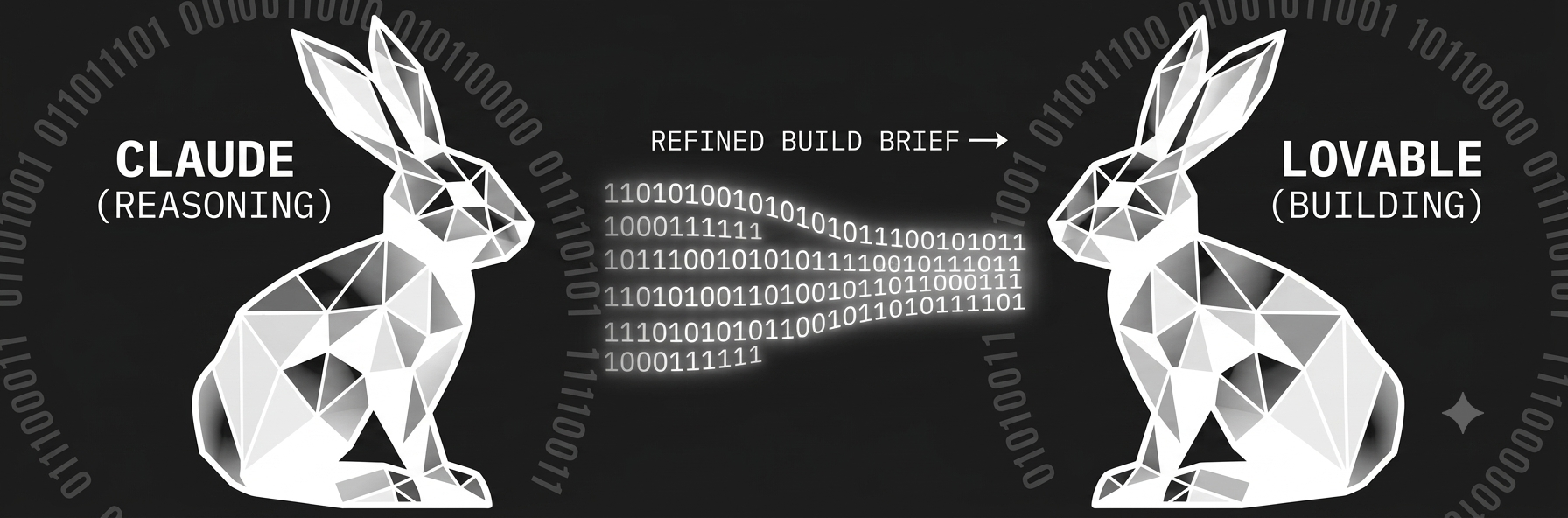
Reason in Claude where exploration is free, then build in Lovable where instructions become running software. A two-step habit that ships better products.
There is a quiet shift happening in how software gets made. A few years ago, turning an idea into a working web application meant writing every line yourself or hiring a team to do it. Today a non technical founder can describe an application in plain language and watch a no code platform like Lovable assemble a real React front end, a database, authentication, and a deployed URL in an afternoon. That is genuinely remarkable. Yet the teams who get the best results are not the ones who simply type whatever comes to mind into the build tool. They are the ones who think first in a reasoning model such as Claude, and only then hand a refined, deliberate prompt to the platform that builds.
Two different jobs that deserve two different tools
It helps to recognize that planning software and generating software are distinct activities. Planning is open ended and conversational. You explore trade offs, change your mind, refine your data model, and reason about edge cases. Generation is committal. The moment a build platform reads your instruction, it writes files, creates database tables, and wires up components. Mixing those two modes in a single window means every half formed thought becomes code that something then has to undo.
Claude is built for the first job. It is a reasoning environment where you can argue with yourself at no cost, because nothing is committed until you say so. Lovable and similar platforms are built for the second job. They turn a clear instruction into a running system. Using each tool for what it does best is the whole idea.
 From reasoning in Claude to a refined build brief to a working Lovable app.
Why the platform itself rewards better prompts
This is not merely a matter of taste. Under the hood, Lovable generates production oriented TypeScript and React, typically backed by a Supabase database for storage, authentication, and access rules. Independent reviews through 2026 consistently note the same pattern. These platforms excel at standard, well described patterns and slow down sharply on vague or unusual logic. They also tend to perform best when individual components stay reasonably small, with quality degrading as a single component balloons in size.
Two practical consequences follow. First, the clarity of your instruction directly shapes the quality of the generated code, because the model is translating your words into architecture. Second, vague prompts cost real money and time. Most of these platforms run on a credit or message system, so every confused instruction that produces the wrong thing burns budget and forces a corrective round. A precise prompt is therefore not just cleaner, it is cheaper.
What thinking in Claude first actually gives you
A data model before a single table exists
The most expensive mistakes in any application live in the data model. Rename a field or restructure a relationship after the fact and you ripple changes through every screen that touched it. In Claude you can design the entire schema as a conversation. What entities exist, how they relate, which fields are required, what should be unique, and how records should be deleted. You arrive at the build platform already knowing that a customer has many orders, that an email must be unique, and that deleting a customer should preserve their order history. That clarity becomes clean tables on the first attempt rather than the third.
Edge cases reasoned through in advance
Generation tools build the happy path well. They are weaker at the awkward questions that decide whether software survives contact with real users. What happens when two people edit the same record at once? What should an empty state look like? How does the system behave when an upload fails halfway? Reasoning through these in Claude first means your prompt already specifies the behavior, so the platform builds it in rather than leaving a gap you discover in production.
A sequence rather than a pile
Complex builds succeed when they are delivered in a deliberate order. Foundation first, then the core feature, then the surrounding flows, validating each layer before the next. Build platforms openly struggle when asked to produce a large, multi part system in one undifferentiated request. Claude is an excellent place to break an ambitious idea into a numbered sequence of build instructions, each one small enough for the platform to execute reliably, each one building on a foundation that already works.
A concrete workflow you can adopt
- Describe the idea to Claude in plain language and let it ask clarifying questions until the concept is sharp.
- Co design the data model explicitly, naming every entity, field, relationship, and rule.
- List the screens and user flows, then reason through the edge cases for each one.
- Ask Claude to produce a structured build brief, ordered into foundation, core feature, and supporting flows.
- Paste each section into Lovable as its own focused prompt, validating the result before moving to the next.
- Use the platform visual editor for small cosmetic tweaks, and return to Claude whenever a change touches logic or data.
The dividing line is simple. Anything structural, anything that touches data, security, or behavior, is reasoned in Claude first. Anything purely visual can be nudged directly in the platform. This keeps the heavy thinking in the tool designed for thinking and the building in the tool designed for building.
The technical credibility this preserves
There is a deeper benefit that matters to anyone who intends to keep the software they build. Because platforms like Lovable generate real code and synchronize it to a Git repository, a professional developer can take over at any point with no lock in. A codebase that grew from clear, well sequenced prompts is dramatically easier to inherit than one assembled through dozens of contradictory instructions. Good thinking upstream produces maintainable code downstream, which protects the option to bring in a development team later without a painful rewrite.
It is worth being honest about the limits too. These platforms are outstanding for validating an idea and shipping an early product, and they are a starting point rather than an endpoint for systems that must handle heavy production traffic or strict enterprise requirements. Knowing where that boundary sits is part of using the approach responsibly, and reasoning it through in Claude is exactly how you find it before it finds you.
A small change in habit, a large change in outcome
None of this asks you to write code. It asks you to separate two kinds of thinking that have always been separate, and to give each one the tool it deserves. Reason, argue, and design in Claude where exploration is free. Build, deploy, and iterate in Lovable where instructions become running software. Teams that adopt this habit ship faster, spend less on wasted generations, and end up with cleaner systems they can actually maintain. At Binary Rabbits we help organizations put exactly this workflow to work, turning sharp thinking into software that lasts.
About the author
Kris Van Hauwermeiren is the founder of Binary Rabbits and a Tech Director with 25+ years of enterprise experience in digital transformation, AI and technical leadership.